

It’s Not Just Memory
When capacity says one thing and everyday life says another.
Theme: The Broken
Quick Take:
Sometimes you know something has changed long before you can explain it.
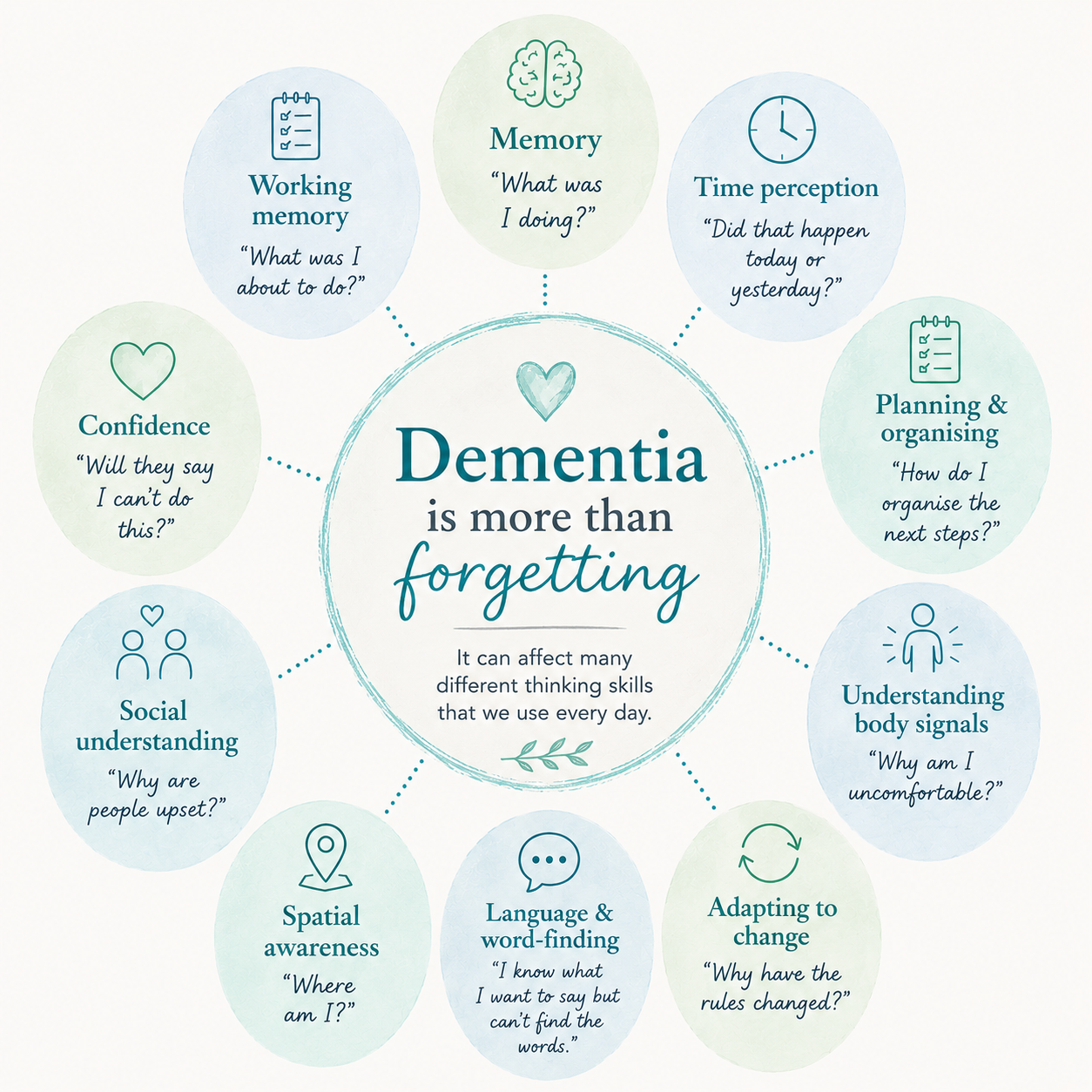
Dementia affects far more than memory.
The family sees the consequences, not just the decision.
It took me Back
I spent time with a friend who is struggling to persuade her mother, and some of the professionals involved in her care, that she is showing clear signs of cognitive decline and can no longer cope safely at home. Her mother has had no diagnostic assessment, only screening that says she has capacity. Meantime she accepts that she is "older and not as strong as I was", but refuses to acknowledge anything more significant.
It reminded me of the frustrating early years with Milly and of how difficult it can be to explain cognitive decline when it doesn't look like the memory loss everyone expects.
When you know something has changed
Many of us notice changes months or even years before an official diagnosis. But they're not the changes that everyone else looks out for.
It's not the forgotten birthdays or names. It's not even trying to remember why they've entered a room.
It's much more than that.
It's the judgement, the planning, the sequencing, the confidence, the ability to cope when something new or unexpected happens.
I knew things had changed with Milly, but I struggled to explain it in a way that people understood or even accepted. She was able to hold a perfectly good conversation and remember important events, so to others she appeared much the same as she’d always been.
If I mentioned to family or friends things were changing it was just that "Milly is quite old" or "she's just like Aunt Molly, a bit dotty!" or "it's living alone, it's since your father died".
My nursing background helped me understand that the brief cognitive tests used by GPs and during hospital stays are often just a starting point. They help identify people who may need further assessment, but they don't always pick up the early or more subtle signs of dementia. Memory Clinic assessments are much more detailed and are designed to build a fuller picture.
That understanding helped me cope with and adapt to the changes I was seeing, but I still sometimes felt isolated and often found myself questioning my own instincts.
The Relief of a Diagnosis
I wasn't particularly concerned about obtaining a formal diagnosis. Getting Milly to an assessment would have been a battle and, at the time, I couldn't see what practical difference it would make.
As time went on, other family members could see that something had changed, so I felt less alone. Milly, however, remained determined to stay independent. Any difficulties she experienced were explained away as "needing to get my act together" or "I've become very lazy". The possibility of dementia frightened her.
As her mental health declined, I eventually persuaded her to attend a Memory Clinic assessment by presenting it as a routine NHS brain health check. She could still score reasonably well on the brief screening tests, but the more comprehensive assessment confirmed mixed dementia - Alzheimer's and vascular dementia.
To my surprise, I felt relieved.
Not because the diagnosis changed anything for Milly, but because it validated what I had been been seeing for years. I no longer felt I had to justify every concern or explain every precaution I was taking.
There was also one small practical benefit. Milly became exempt from Council Tax under the severe mental impairment rules, which helped ease some of the financial pressure.
What I didn't realise was that a diagnosis would bring a different challenge altogether.
Capacity Isn't Capability
After diagnosis, I assumed it would be easier to have conversations about support, routines and future planning.
Instead, I encountered a new frustration.
Milly could explain clearly what she wanted. Professionals would often conclude that she had the capacity to make her own decisions.
The Mental Capacity Act of 2005 requires us to assume capacity unless it can be shown otherwise. People are also entitled to make decisions that others consider unwise.
Of course I can see that this principle is important. But I was watching and managing the reality of everyday life: forgotten meals, difficulty working out what came next, confusion when routines changed, growing anxiety and a steady loss of confidence.
This is where I learned one of the most important lessons of dementia care: capacity and capability are not the same thing.
Capacity asks:
"Can this person make this decision?"
Can they understand information, weigh up options and communicate a choice?
Capability asks something different:
"Can they live safely with the consequences of that decision?"
Can they manage everyday life consistently? Can they organise, plan and adapt when things go wrong?
Those are not the same.
Someone may have the capacity to decide they want to live independently while struggling with many of the practical skills that independent living requires.
This is where the gap between professional observations and family experience becomes most apparent.
Feeling Vulnerable, Feeling Unheard
I knew Milly would be considered to have the capacity to decide she wanted to continue to live independently and to refuse helpful routines and social activities, such as a lunch club for the elderly.
("Oh no, that's not for me. Not yet anyway!")
But I also knew she was struggling with many of the practical tasks that independent living requires.
That distinction explains why I felt, and I know so many loved ones feel, unheard. The professional may see someone for twenty minutes at their best.
The family sees what happens over twenty-four hours.
The professional sees the decision. The family sees the consequences.
The Biggest Misunderstanding
Then there is the biggest misunderstanding - that dementia is all about memory loss.
Memory loss is often the only thing people are taught to look for.
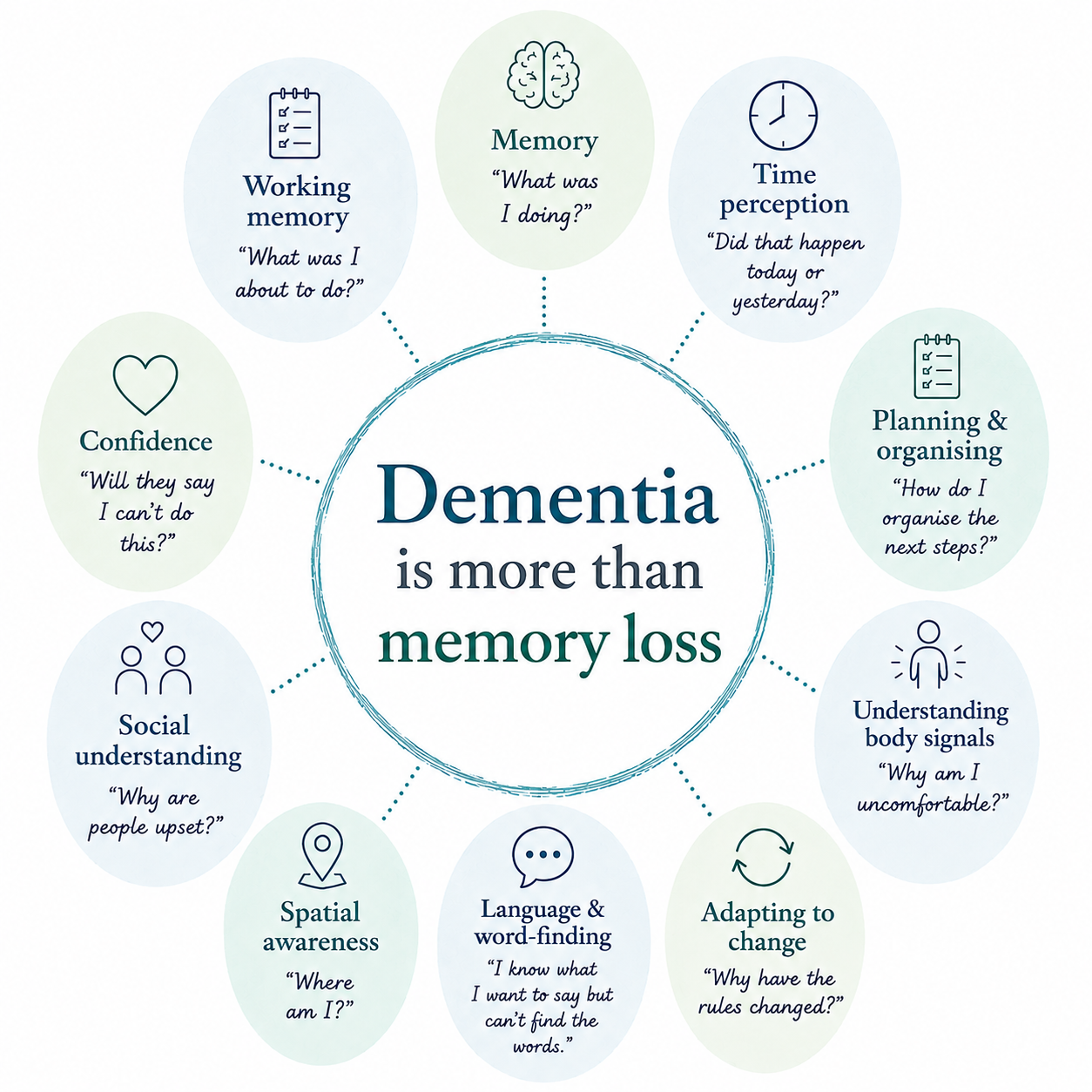
I created the image above to highlight the aspects of dementia that are so often overlooked. Memory loss is only one part of the picture. Dementia can also affect judgement, planning, confidence, language, spatial awareness, time perception, problem solving and the ability to adapt to change, often long before severe memory difficulties appear.
Sometimes the people closest to someone with dementia are not primarily worried about what they have forgotten.
They're worried about everything else.
And until we start to understand dementia as more than memory loss, families will continue to struggle to explain what they are seeing and why they are worried.
This is also why I believe dementia training needs looking at urgently.
Wider Focus Needed
Much of the focus of carer training remains on memory loss, risk management and restrictive practice. Those things matter, but carers also need help understanding the wider impact of cognitive decline and how it affects everyday life.
I have seen this repeatedly with Milly. Someone may spend an hour or two with her and then say, often in front of her, "Her memory’s good, isn't it? She's not too bad at all."
What they are seeing is a conversation. What they are not seeing is the confusion when routines change, the difficulty planning the next step, the anxiety, the loss of confidence and the effort required to hold things together.
Sadly, as long as memory loss remains the main focus of carer training and public awareness campaigns, families will continue to struggle to explain what they are seeing and professionals will continue to miss part of the picture.